Commercial · Peterborough
Access Control Installation in Peterborough
Another employee left and the keys never came back. You changed the locks again, cut copies for everyone who stayed, and paid for a job that repeats itself the next time someone quits, taking a working key out the door with them.
Access Control Installation
In plain words
A building already running an intrusion alarm or a camera system gains from an access control installation that speaks to them rather than sitting apart from them: an arm-and-disarm event that lines up with the person who unlocked the door, a camera clip tagged to a specific credential instead of a blank time stamp. The reader and the lock still do the physical work of the opening; the value is in how the record from that opening lines up with everything else the building already tracks.
How the visit goesThe keypad on the side door has started sticking on cold mornings, codes get shared instead of reset, and half the staff still remember a code you meant to retire two hires ago.
Peterborough
How the visit goes
Checking which doors are also exits
A door that leads outside along a path people use to leave the building gets special attention, no matter what lock currently sits on it, so the survey flags every one of those openings early. On an exit door, a magnetic lock only gets considered alongside a request-to-exit device and a tie-in to the fire alarm system, while an electric strike paired with a standard latch usually needs no extra hardware to let people out. Sorting exit doors from interior doors before any hardware is ordered keeps a smooth, one-motion exit part of the plan from day one rather than a fix added afterward.
Wiring the openings back to a controller
Each controlled opening can send and receive several signals: a reader reporting a presented credential, a lock output that releases the hardware, and, where the configuration calls for them, a door position switch reporting open or closed and a request-to-exit input. The locksmith runs the wiring from each opening back to wherever the controller is mounted — as a home run, along a shared bus, or over the network on an IP or PoE device — labels each conductor at both ends, and terminates them into the controller's input and output boards. A building with several openings may share one power supply and battery backup sized to the combined load, or split the load across more than one supply.
What to do when a card or fob goes missing
A lost card or fob is handled by switching it off in the software rather than replacing a lock. The credential stops working as soon as it is disabled, whoever lost it is issued a new one, and every other door in the building keeps running exactly as it did before. There is no locksmith call needed for this, no rekeying, and no gap where a door sits unsecured while a replacement is arranged. Reporting a lost credential without delay, rather than holding onto the news, is the one habit that keeps this advantage working the way it was intended.
Access Control Installation
In the van
- Door position switches
- Electric strikes
- Power supply with battery backup
- Fire alarm interface relay
- Keypad readers
What affects the quote
Same fees day, night or weekend
1Electric strike or magnetic lock
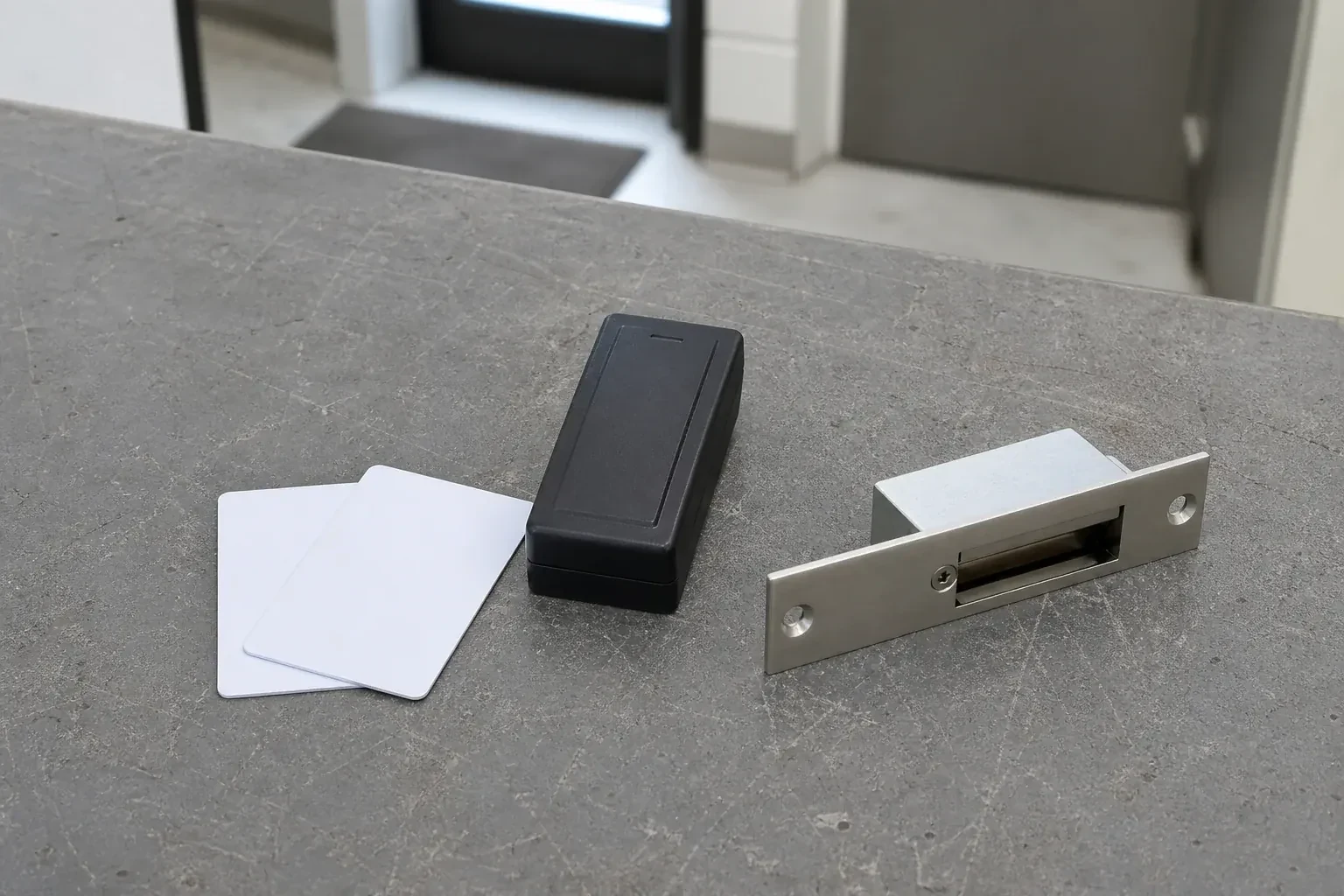
An electric strike works with the door's existing latch and generally needs less additional hardware than a magnetic lock, which also calls for a request-to-exit device and, on an exit door, a fire alarm tie-in.
2Room left for future doors
Sizing the controller and power supply with some spare capacity for a door or two added later costs a little more at installation but avoids a second controller purchase when the building later adds an opening.
3Whether any door is also a fire exit
An exit route on a magnetic lock brings its own hardware — a request-to-exit device and a fire alarm tie-in — while an electric strike paired with a free-egress lockset can meet the same one-motion exit without those extra components, unlike a purely interior door.
Access Control Installation: questions
How do you decide where the readers and door hardware physically go?
A short walk-through maps which doors get used most, where wiring can run cleanly, and where a reader sits at a comfortable reach for everyone, including anyone using a wheelchair or a cart. Door swing and nearby glass affect where a strike or a magnetic lock sits, and mounting height gets checked against the existing door hardware so nothing interferes with the handle or closer. That walk-through happens before ordering hardware so the layout matches the building rather than the other way around.
What maintenance does the system need going forward?
Ongoing maintenance is light: checking the battery backup and the request-to-exit device periodically, keeping reader surfaces reasonably clean, and revoking credentials promptly once someone leaves. Door and frame alignment is worth a look at each change of season, since a shifted door can affect how cleanly an electric strike or a magnetic lock releases.
What happens to the doors if the power goes out?
Outage behaviour depends on how that opening was built: battery backup can be sized to carry the reader, the lock and the controller through a typical outage, so a brief power loss need not lock anyone out or, on a fire-alarm-tied opening, lock anyone in, but that backup and any mechanical key override are specified per opening rather than assumed for every door. Fail-safe hardware unlocks once power has been out longer than the backup lasts; fail-secure hardware stays locked, and what opens it depends on the hardware chosen.
Commercial Locks
- Master Key System DesignA self-storage operator wants the office, the tenant gate and the equipment shed on three different…
- Panic & Exit HardwareTwo doors used to swing as a pair at the community hall entrance, but one leaf has started closing…
- Commercial-Grade Lock ReplacementAn inspection report flagged the rear exit as needing hardware that opens with one motion and no…
Access Control Installation near you
From the front door of a house to the back door of a warehouse, the work in Peterborough comes down to a few families of jobs: getting in, changing who can get in, making it harder for the wrong people to get in, and keeping the hardware turning smoothly year after year. Browse the list to find yours.