Commercial · Selwyn
Access Control Installation in Selwyn
Another employee left and the keys never came back. You changed the locks again, cut copies for everyone who stayed, and paid for a job that repeats itself the next time someone quits, taking a working key out the door with them.
Access Control Installation
In plain words
Access control installation swaps a shared metal key for an electronic one: a card, a fob, a code, or a phone tap that a controller checks against a list the business manages. When someone leaves the company, their credential is switched off in seconds instead of triggering a rekey of every door they could open. The reader and locking hardware go in at each entrance that needs it, wired to a controller that holds the schedule, and the whole system is handed to the business to run once it has been tested and confirmed working.
How the visit goesThe team has grown past the point where one shared key still makes sense. New hires need a way in before a manager arrives, and the current setup cannot tell one person's entry from another's.
Selwyn
How the visit goes
Sorting out a shared entrance
In a multi-tenant building, the survey has to account for doors that are not fully any one tenant's to control: a shared lobby, a parking garage entrance, a rooftop or mechanical room a landlord manages separately. The locksmith works out with the property manager and each tenant which credentials belong on which controller, so a tenant's staff can reach their own suite without gaining access to another business's space or to areas the landlord keeps under its own control, and so a departing tenant's credentials can be removed without touching anyone else's.
Commissioning day: training the people who will run it
The last step is not technical: it is sitting down with whoever will administer the system and walking through adding a person, revoking a lost card, pulling an entry log for a specific door and date, and changing a schedule for an upcoming holiday or event. The locksmith answers questions on the spot rather than leaving a manual to be read later, confirms the administrator account works with full access, and leaves contact information for anything that comes up once the system has settled into daily use.
Running the system day to day
From the day the installation is finished, adding or removing a credential is a task the business handles itself, usually in minutes: a new hire is enrolled before their first shift, and someone who has left the company is switched off as soon as it is reported, rather than waiting for a lock to be changed. The administrator account holds this control, and whatever support or maintenance access the installer keeps beyond that is set out at handover rather than assumed either way. Most businesses find this the biggest day-to-day change from a mechanical key: entry stops being tied to a physical object that has to be tracked down and collected.
Access Control Installation
In the van
- Door position switches
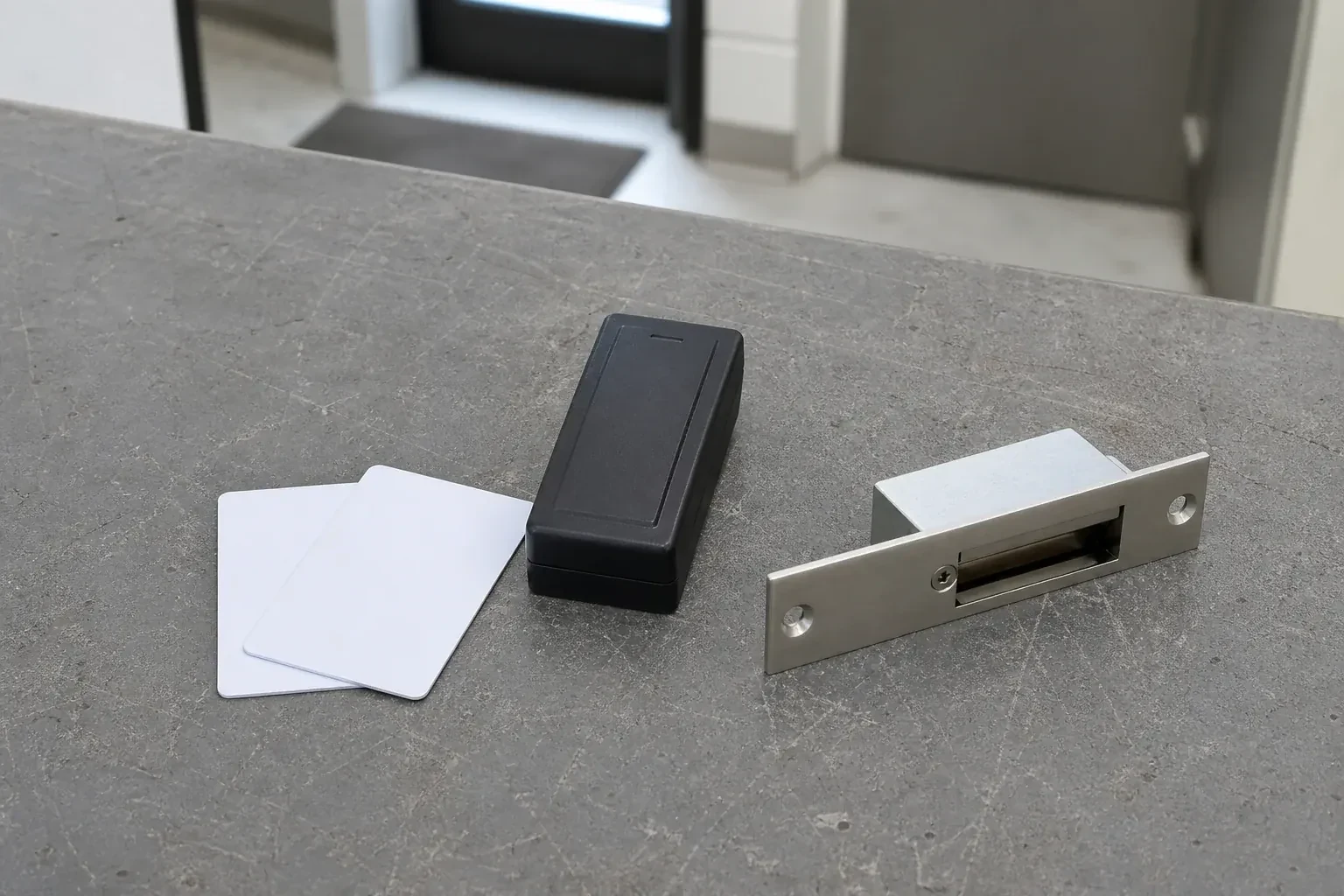
- Electric strikes
- Power supply with battery backup
- Fire alarm interface relay
- Keypad readers
What affects the quote
Same fees day, night or weekend
1Coordinating a shared or multi-tenant entrance
A shared lobby or parking entrance in a multi-tenant building needs agreement between the property manager and each tenant on which credentials belong where, and that coordination adds time beyond a single business's own doors.
2What cabling already exists
Exposed ceilings, accessible risers or existing conduit make running new low-voltage cable straightforward; finished walls and long runs between openings and the controller location add time and materials to the same job.
3Whether any door is also a fire exit
An exit route on a magnetic lock brings its own hardware — a request-to-exit device and a fire alarm tie-in — while an electric strike paired with a free-egress lockset can meet the same one-motion exit without those extra components, unlike a purely interior door.
Access Control Installation: questions
How do you decide where the readers and door hardware physically go?
A short walk-through maps which doors get used most, where wiring can run cleanly, and where a reader sits at a comfortable reach for everyone, including anyone using a wheelchair or a cart. Door swing and nearby glass affect where a strike or a magnetic lock sits, and mounting height gets checked against the existing door hardware so nothing interferes with the handle or closer. That walk-through happens before ordering hardware so the layout matches the building rather than the other way around.
What maintenance does the system need going forward?
Ongoing maintenance is light: checking the battery backup and the request-to-exit device periodically, keeping reader surfaces reasonably clean, and revoking credentials promptly once someone leaves. Door and frame alignment is worth a look at each change of season, since a shifted door can affect how cleanly an electric strike or a magnetic lock releases.
What happens to the doors if the power goes out?
Outage behaviour depends on how that opening was built: battery backup can be sized to carry the reader, the lock and the controller through a typical outage, so a brief power loss need not lock anyone out or, on a fire-alarm-tied opening, lock anyone in, but that backup and any mechanical key override are specified per opening rather than assumed for every door. Fail-safe hardware unlocks once power has been out longer than the backup lasts; fail-secure hardware stays locked, and what opens it depends on the hardware chosen.
Commercial Locks

- Master Key System DesignA self-storage operator wants the office, the tenant gate and the equipment shed on three different…
- Panic & Exit HardwareTwo doors used to swing as a pair at the community hall entrance, but one leaf has started closing…
- Commercial-Grade Lock ReplacementAn inspection report flagged the rear exit as needing hardware that opens with one motion and no…
Access Control Installation near you
From the front door of a house to the back door of a warehouse, the work in Selwyn comes down to a few families of jobs: getting in, changing who can get in, making it harder for the wrong people to get in, and keeping the hardware turning smoothly year after year. Browse the list to find yours.