Commercial · Peterborough
Panic & Exit Hardware
Two doors used to swing as a pair at the community hall entrance, but one leaf has started closing before the other, catching the astragal and leaving a gap wide enough to worry the caretaker.
Panic & Exit Hardware
In plain words
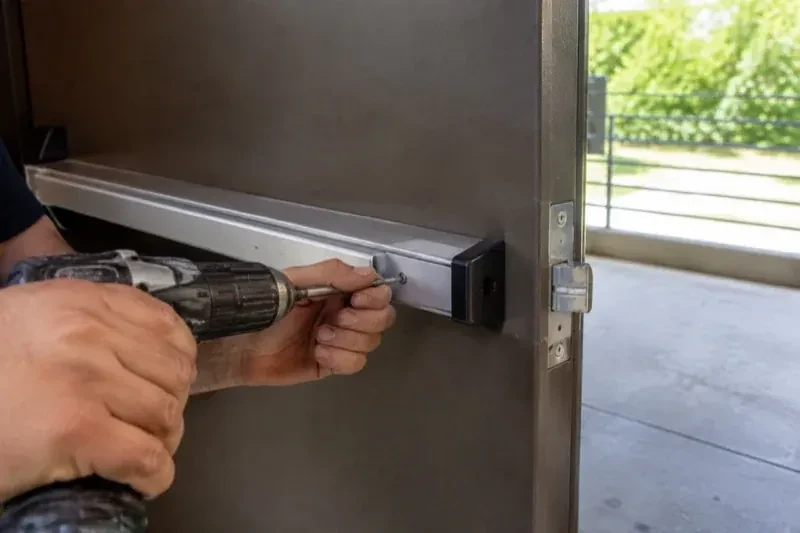
Panic and exit hardware installation fits a commercial door with a device that releases the latch the moment someone pushes on it from the inside, so the room's occupants are never asked to find a key to leave. The locksmith works from the room's occupancy and the door's fire rating first, then chooses a rim, mortise or vertical-rod device to suit the opening, pairs it with outside trim that still controls entry, and tests the release force and the latch before handing the door back. Any electrified addition, such as an alarm or a link to access control, is fitted once that basic function is confirmed.
How the visit goesAfter the fit-out, the gym floor now holds more people than the old office space ever did, and the exit door at the back still has the same turn-lock it had when the room held desks.
Peterborough
How the visit goes
Confirming why the door needs this hardware
The visit starts with the reason exit hardware is being discussed at all: an occupant load that has crossed a threshold, a fire inspector's note, a new use for the room, or an existing device that has stopped working the way it should. Confirming this first decides everything downstream, because a door required to have a releasing device is treated differently from one where an owner simply wants easier egress. Whoever is responsible for the building is asked directly what triggered the visit, and the answer is recorded alongside the door it concerns before any hardware is chosen.
Handling a pair of doors
On a pair, a coordinator is fitted only where the hardware needs the leaves to close in a set order, letting the active leaf's device seat into the strike or into an astragal carried on the inactive leaf; many pairs latch independently and skip this step entirely. Where the plan calls for one wide exit instead of two narrow ones, the centre mullion is removed and vertical-rod devices are fitted to each leaf instead, arranged so both close and latch reliably. Either way, both leaves are tested together, not only on their own, before the visit is called finished.
A maintenance rhythm worth keeping
Exit devices are mechanical hardware and benefit from the same light attention as any other: a periodic check that the release force has not crept up, that the latch still seats fully, and that nothing has been added to the door that would block its exit function. Fire door assemblies carry their own inspection and testing rhythm, and folding the exit hardware into that same routine check keeps the whole opening, not just the lock, in the condition it was fitted in.
Panic & Exit Hardware
In the van
- Door closer
- Request-to-exit switch
- Astragal and mullion hardware
- Strike and reinforcement
- Outside trim (pull, lever or cylinder)
What affects the quote
Same fees day, night or weekend
1Weatherproofing for an exterior opening
An exterior device, strike and trim built to handle temperature swings and moisture cost more as hardware than an equivalent interior-only set, and the quote reflects that difference in the parts themselves.
2Outside trim selected
A plain pull is the simplest outside trim. A lever with a key cylinder, or a trim matched to other hardware finishes in the building, involves more parts and more fitting time.
3Access to the opening
A ground-floor commercial door is straightforward to reach. An opening behind scaffolding, up a stairwell with no elevator, or in a space still under active construction takes longer to work at.
Panic & Exit Hardware: questions
What counts as panic hardware?
Panic hardware is a door-latching device, usually a crossbar or touchpad running most of the door's width, that releases the latch the moment someone pushes on it from the inside. It is built and tested so a light, even push anywhere along the bar opens the door, which is why it is chosen for doors serving rooms with enough people that fumbling for a key during an exit is not acceptable.
What outside trim options exist for an exit device?
A plain pull suits a door nobody needs to lock from outside. A lever with a key cylinder lets authorized people turn the handle and enter while the inside stays a simple push. A keyed cylinder alone, without a lever, suits occasional entry where a full handle is not needed. All three leave the inside crossbar untouched, since the trim only ever affects the outside.
Can I still lock the door from outside?
Yes. The releasing device only governs the inside of the door; the outside gets its own trim, a pull, a lever with a cylinder, or a keyed cylinder alone, chosen for how that door is entered. Locking or unlocking that outside trim has no effect on the inside crossbar, which always releases the latch under a push, so entry security and exit function are handled as two separate questions.
Commercial Locks
- Master Key System DesignA self-storage operator wants the office, the tenant gate and the equipment shed on three different…
- Access Control InstallationAnother employee left and the keys never came back.
- Commercial-Grade Lock ReplacementAn inspection report flagged the rear exit as needing hardware that opens with one motion and no…
Panic & Exit Hardware near you
From the front door of a house to the back door of a warehouse, the work in Peterborough comes down to a few families of jobs: getting in, changing who can get in, making it harder for the wrong people to get in, and keeping the hardware turning smoothly year after year. Browse the list to find yours.