Commercial · Woodland Acres
Panic & Exit Hardware in Woodland Acres
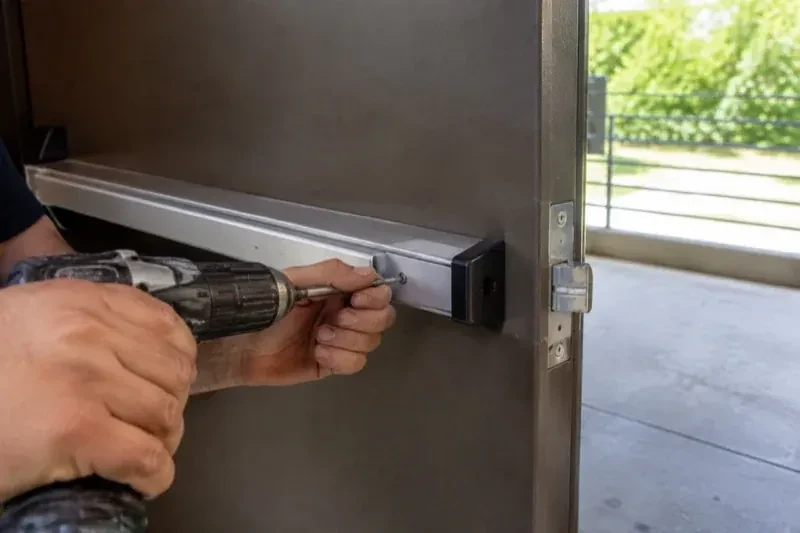
Two doors used to swing as a pair at the community hall entrance, but one leaf has started closing before the other, catching the astragal and leaving a gap wide enough to worry the caretaker.
Panic & Exit Hardware
In plain words
The visit ends with a record, not just a working door. Every device fitted is logged with its type, its rating, the force and latch checks it passed, and who now holds the dogging key. That record is what a fire inspector, an insurer or a new property manager asks for later, and it is far easier to hand over on the day of installation than to reconstruct afterward from memory of what went on which door.
How the visit goesTwo doors used to swing as a pair at the community hall entrance, but one leaf has started closing before the other, catching the astragal and leaving a gap wide enough to worry the caretaker.
Woodland Acres
How the visit goes
Is this door part of a pair?
Single doors and pairs get assessed differently from the first look. On a pair, the locksmith checks whether a mullion currently splits the opening, whether a coordinator is already fitted, and whether the leaves close independently or in a set order. This decides whether the project is a straightforward device swap on each leaf or something larger, such as removing a mullion and fitting a compatible replacement latching arrangement to turn two narrow doors into one wide exit. Getting this right at the assessment stage avoids ordering hardware for a single door when the opening is really two leaves working together.
Handling a pair of doors
On a pair, a coordinator is fitted only where the hardware needs the leaves to close in a set order, letting the active leaf's device seat into the strike or into an astragal carried on the inactive leaf; many pairs latch independently and skip this step entirely. Where the plan calls for one wide exit instead of two narrow ones, the centre mullion is removed and vertical-rod devices are fitted to each leaf instead, arranged so both close and latch reliably. Either way, both leaves are tested together, not only on their own, before the visit is called finished.
Electrified functions folded into the building's other systems
Any request-to-exit signal, latch retraction or alarm added during the visit now does its own specific job rather than one combined function: an alarm module can sound locally on its own power the moment the crossbar is used, latch retraction lets an authorized signal release the latch for entry, and a request-to-exit signal tells the access-control panel that the pushpad was actuated. None of them alone proves who passed through or from which side, and the exit function itself remains entirely mechanical underneath, so a power interruption still leaves the door able to be pushed open by hand from the inside.
Panic & Exit Hardware
In the van
- Door closer
- Request-to-exit switch
- Astragal and mullion hardware
- Strike and reinforcement
- Outside trim (pull, lever or cylinder)
What affects the quote
Same fees day, night or weekend
1Condition of the existing hardware
A device that only needs adjustment, cleaning and new fasteners costs less in labour than removing a seized or badly worn device and fitting a replacement in its place.
2Electrified functions added
A request-to-exit switch or electric latch retraction adds wiring, a power source and coordination with the building's other systems, while a standalone alarm module can run on its own battery; each is priced alongside the mechanical installation itself.
3Fire-rated versus non-rated opening
A fire-rated door needs hardware specifically listed for that assembly and installed to keep the rating intact, which is more involved than fitting a standard device to a non-rated door.
Panic & Exit Hardware: questions
What counts as panic hardware?
Panic hardware is a door-latching device, usually a crossbar or touchpad running most of the door's width, that releases the latch the moment someone pushes on it from the inside. It is built and tested so a light, even push anywhere along the bar opens the door, which is why it is chosen for doors serving rooms with enough people that fumbling for a key during an exit is not acceptable.
What outside trim options exist for an exit device?
A plain pull suits a door nobody needs to lock from outside. A lever with a key cylinder lets authorized people turn the handle and enter while the inside stays a simple push. A keyed cylinder alone, without a lever, suits occasional entry where a full handle is not needed. All three leave the inside crossbar untouched, since the trim only ever affects the outside.
Can I still lock the door from outside?
Yes. The releasing device only governs the inside of the door; the outside gets its own trim, a pull, a lever with a cylinder, or a keyed cylinder alone, chosen for how that door is entered. Locking or unlocking that outside trim has no effect on the inside crossbar, which always releases the latch under a push, so entry security and exit function are handled as two separate questions.
Commercial Locks
- Master Key System DesignA self-storage operator wants the office, the tenant gate and the equipment shed on three different…
- Access Control InstallationAnother employee left and the keys never came back.
- Commercial-Grade Lock ReplacementAn inspection report flagged the rear exit as needing hardware that opens with one motion and no…
Panic & Exit Hardware near you
Whether you own a home in Woodland Acres, run a shop or manage a few rental units, the lock services here are organised the way people actually ask for them. Start with the problem you have today, and read on to see what else on the door might deserve a look while a locksmith is already there.